
How a Bengals–Steelers upset, an astrology experiment, and one perfectly timed line from the broadcast became the beginning of SportSkopes
SportSkopes did not begin with a business plan.
It began because my wife didn’t understand why I was watching the Cincinnati Bengals.
This was late 2020. Kelsey and I had been together for less than a year and had recently moved in together. I had always been the sports fan. She decidedly was not.
Kelsey was interested in a very different universe: astrology, mythology, plants, cats, and Trader Joes.
The funny thing is, I had always been interested in that world too.
I’m a lifelong Seahawks fan and a data nerd, but I’m also the kind of person who will happily read about ancient civilizations, mythology, astronomy or metaphysics. When Kelsey and I first started dating, I think I earned a few points by knowing my rising sign when she asked.
So there was already some overlap between our worlds.
We just hadn’t found it in football yet.
“Why Are You Watching the Bengals?”
One afternoon, I was watching a random Bengals game.
Kelsey looked at the television and asked a perfectly reasonable question:
Why?
They weren’t the Seahawks. I wasn’t from Cincinnati. I had no obvious connection to either team.
I tried explaining something sports fans understand almost instinctively.
You don’t only watch your own team.
You start following the stories.
There’s a young player who might become great. A terrible team might finally be building something. A rivalry is getting interesting.
Once you know the characters, almost any game can become interesting.
But none of that meant much to Kelsey.
So I tried translating football into something she already understood.
I pulled out my phone, looked up Joe Burrow’s birthday and said to her:
“I bet you’d care more if you knew Joe Burrow was a Sagittarius.”
Suddenly, she did.
Not enough to start breaking down coverages with me. But enough to ask another question. Enough to look at the screen differently.
And that tiny interaction planted an idea.
What if there were another way into sports?
What if astrology could give someone who had never cared about a football game a reason to care about the people playing in it?
And if it could do that for one player, what happened when you looked at an entire team?
Or two teams?
Or the exact moment they played each other?
That was the first spark of SportSkopes.
Then I Found the Christmas Star
A few days later, I started experimenting.
I looked up major astrological events happening around the NFL schedule and came across something unusual.
On December 21, 2020, Jupiter and Saturn would appear exceptionally close together in the sky in what became widely known as the “Christmas Star”—a rare Great Conjunction.
And that same night, the Pittsburgh Steelers were traveling to Cincinnati to play the Bengals.
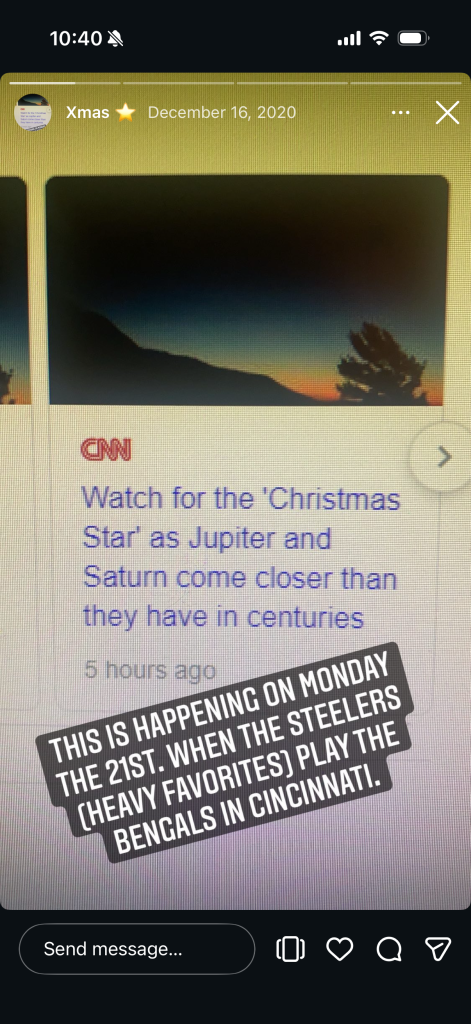
At the time, the matchup did not look particularly interesting.
Pittsburgh was 11–3.
Cincinnati was 2–10–1.
The Steelers had recently stumbled after starting the season 11–0, but Cincinnati still looked like the kind of opponent Pittsburgh should beat while getting itself back on track.
Vegas agreed.
The Bengals were roughly 12-point underdogs.
Their moneyline was around +565.
In other words: almost nobody expected Cincinnati to win.
That made it a perfect experiment.
The First Spreadsheet
I did what I naturally do when I become interested in an idea.
I opened Excel.
I started compiling NFL players, birthdays, zodiac signs and elements.
There was no sophisticated scoring system. No Cosmic Chemistry model. No automated planetary engine. No beautifully designed matchup dashboard.
There was just a spreadsheet.
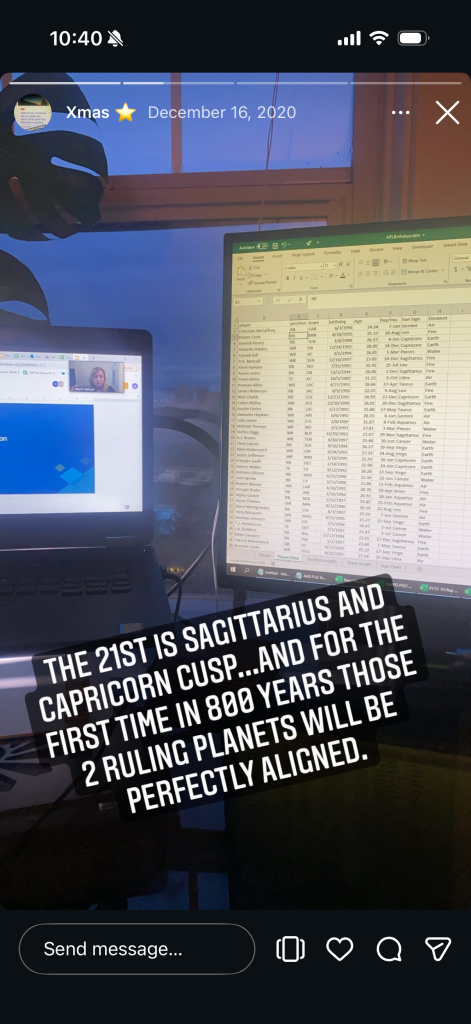
I compared the offensive personnel for Cincinnati and Pittsburgh and began looking at how the teams’ astrological makeup interacted with what I believed the Great Conjunction represented.
Something stood out.
Cincinnati seemed unusually interesting.
There was enough fire energy on the Bengals side, and enough contrast with Pittsburgh’s roster, that the massive point spread suddenly looked much less obvious to me.
I didn’t have a mature methodology yet.
But I had enough of a thesis to make a prediction.
And I wanted proof that I had made it before the game.
So five days before kickoff, I posted it to Instagram.
The First SportSkopes Prediction
At the time, SportSkopes wasn’t even called SportSkopes.
I posted the experiment under #Sportscope.
The post was half serious analysis, half me having fun with something strange I had stumbled into.
But the prediction itself was clear.
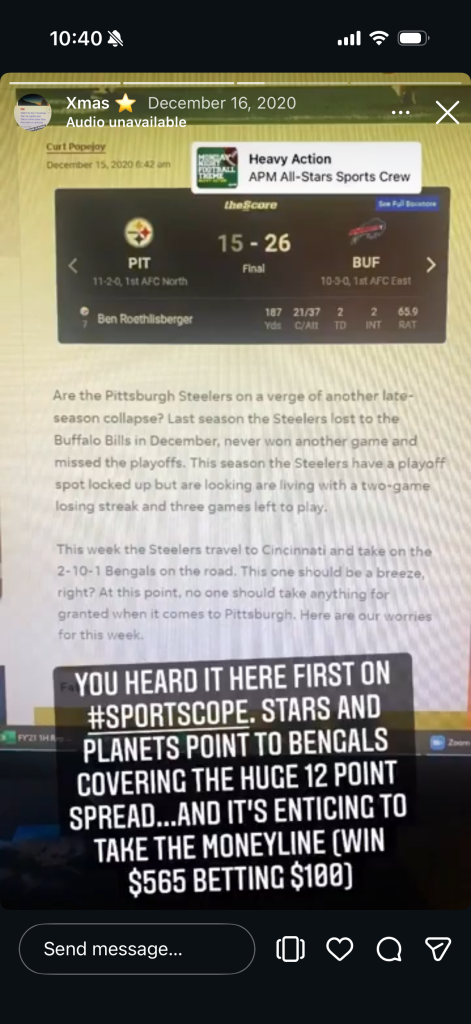
I wrote:
“You heard it here first… stars and planets point to Bengals covering the huge 12 point spread…and it’s enticing to take the moneyline.”
Looking back, it is primitive compared with what SportSkopes has become.
But that screenshot matters to me.
Because it captured the idea before I knew whether any of it would work.
Then Monday night arrived.
Something Strange Started Happening
Kelsey watched the game with me.
That alone was already evidence that the original idea had done something.
She had a reason to care now.
We weren’t just watching Steelers–Bengals.
We were watching the experiment.
And almost immediately, the game started feeling unusual.
Cincinnati wasn’t simply hanging around.
The Bengals looked comfortable.
They forced turnovers. They made timely plays. The ball seemed to keep finding its way toward Cincinnati. Pittsburgh, meanwhile, looked strangely out of rhythm.
The Steelers had chances and kept making mistakes.
The Bengals just kept executing.
By halftime, Cincinnati led 17–0.
Kelsey and I were now fully invested.
Pittsburgh eventually started fighting back. The Steelers cut into the lead and threatened to turn the game back into what everyone had expected.
But Cincinnati didn’t collapse.
And then, somewhere during the fourth quarter, came the moment I still remember most clearly.
One of the broadcasters said:
The stars must be aligned for the Bengals tonight.
Kelsey and I looked at each other.
Huge eyes.
Then we started grabbing each other and laughing.
What the hell?
For the previous several days, that was almost literally the premise of the experiment.
Now an NFL broadcaster had just said it on television while one of the biggest underdogs of the week was finishing the upset.
It felt absurd.
And perfect.
Bengals 27. Steelers 17.
Cincinnati finished it.
The 2–10–1 Bengals beat the 11–3 Steelers 27–17.
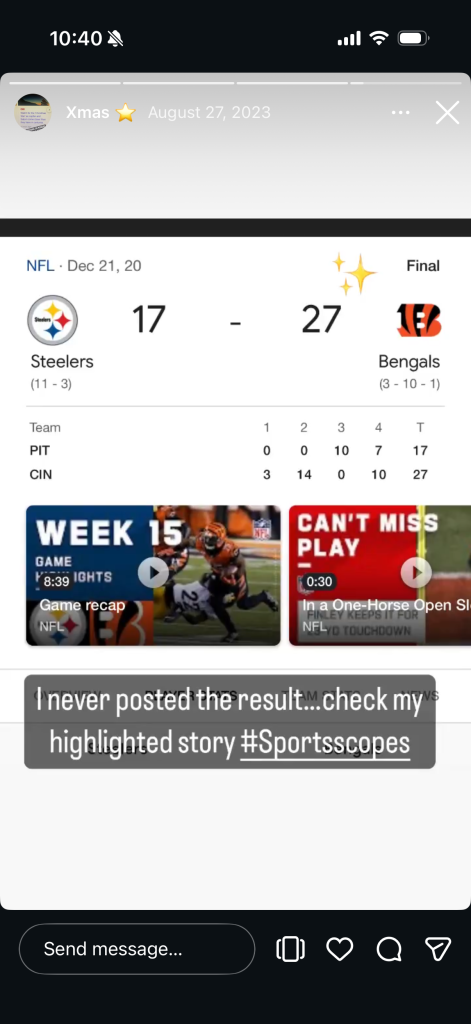
The prediction had hit.
Cincinnati covered easily.
And anyone ballsy enough to take that +565 moneyline had a very good night.
But that wasn’t actually the most important thing that happened.
The important thing was sitting next to me on the couch.
Kelsey had cared about the game.
That Was the Real Idea
It would have been easy to walk away from that night thinking:
Maybe astrology can predict football.
That question is still part of what makes SportSkopes interesting.
But over time, I realized the bigger idea was something else entirely.
Astrology had given someone a new way into sports.
Kelsey did not suddenly become interested because Cincinnati had a better EPA per play.
She became interested because there was a story connecting personalities, timing, astrology and competition.
The game had acquired another layer.
And once that happened, she wanted to see what happened next.
That insight became much more important to me than correctly picking one massive upset.
Sports are already full of statistics.
What they can always use more of are reasons to care.
A relationship between two players.
A strange moment in a season.
The personalities that make one roster different from another.
The mythology surrounding a franchise.
The timing of a matchup.
The feeling that something unusual might be happening tonight.
Those are the spaces SportSkopes exists to explore.
From One Spreadsheet to SportSkopes
The idea stayed with me.
I bought the domain.
I eventually told my friend Blake about it and asked whether he would be interested in helping me build it.
I continued developing the framework behind the original spreadsheet—thinking about players not merely as individual Sun signs, but as combinations of placements, personalities, relationships and roles within a team.
Over time, the original experiment began turning into a much larger system.
Player profiles.
Cosmic Chemistry.
Team identities.
Matchup analysis.
Planetary modifiers.
Season-long events.
Historical research.
Storytelling.
And eventually, a platform designed to expand beyond one sport.
The technology has changed considerably since that first Excel sheet.
The original idea has not.
A New Reason to Watch
SportSkopes exists because sometimes the difference between caring about a game and ignoring it is simply being given the right story.
For one person, that story might be a playoff race.
For another, a rookie quarterback.
For someone else, it might be discovering that the player on the screen shares their zodiac sign.
And occasionally, it might involve two planets meeting in the sky while a 2–10–1 football team prepares to shock an 11–3 favorite.
SportSkopes is our attempt to explore those connections.
Not to replace sports analytics.
Not to claim that the stars determine who wins.
But to ask different questions, build new ways of looking at competition, and create another doorway into the games people already love.
And for people who never thought sports were for them?
Maybe give them a reason to watch too.
It all started with a random Bengals game, an Excel spreadsheet, and one question from Kelsey:
“Why are you watching this?”
We’re still answering it.