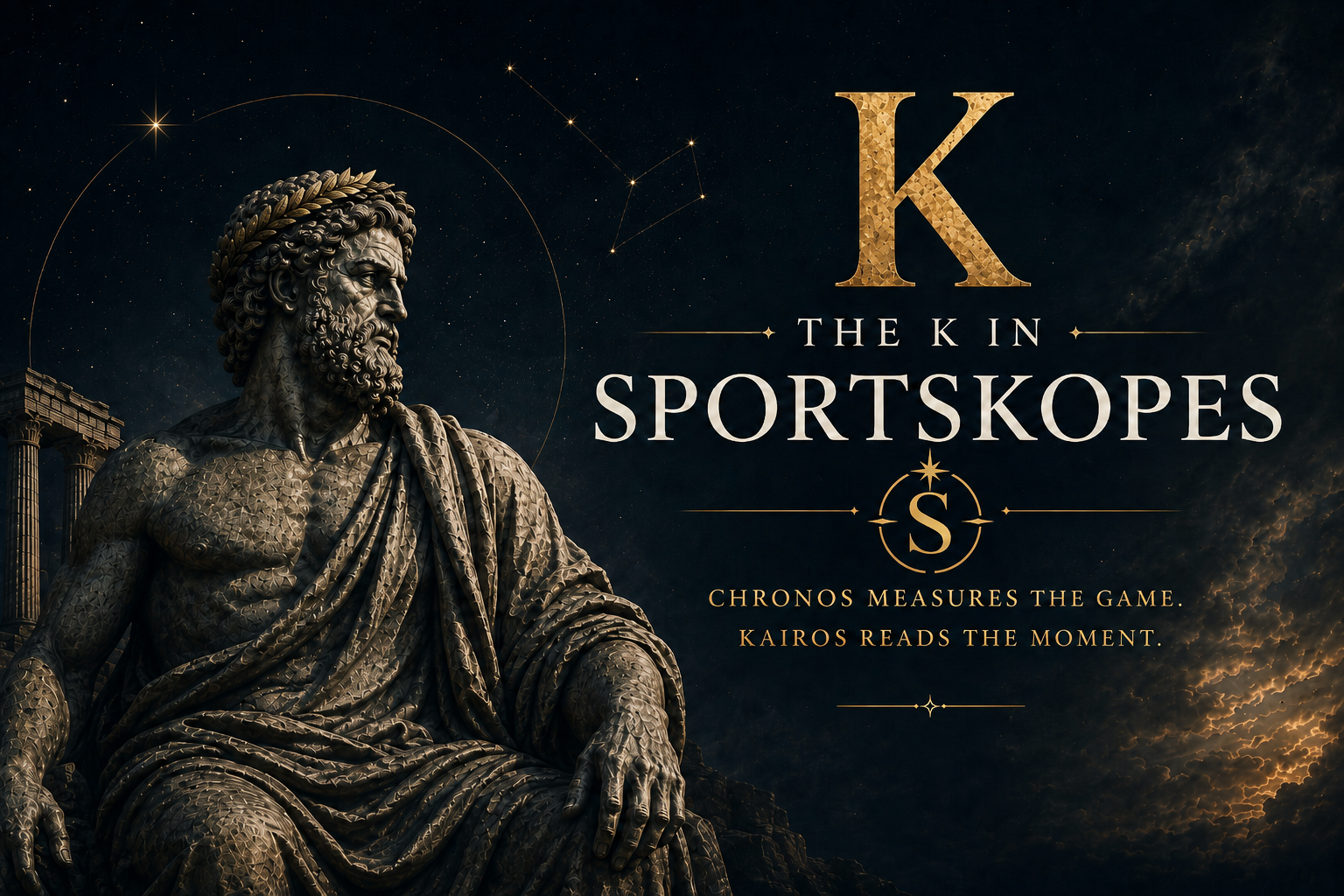
The ancient Greeks had more than one way of thinking about time. Chronos (χρόνος) described time as we most commonly understand it today: chronological, sequential and measurable. Kairos (καιρός) meant something different—the critical or opportune moment, when the quality of time mattered more than its quantity. Chronos asks when? Kairos asks what kind of moment is this?
Modern sports are, in many ways, an extraordinary study of Chronos. We measure forty-yard dash times to the hundredth of a second. We track snap counts, possession, efficiency, win probability and thousands of other data points. Seasons become datasets, careers become timelines, and increasingly sophisticated models help us understand what happened and what is statistically likely to happen next. Chronos gives us the measurable structure of the game.
But anyone who follows sports knows that numbers do not capture everything that makes a moment significant. A roster can look perfect on paper and never quite come together. A player can arrive on a new team at exactly the right point in his career. Chemistry can change, momentum can build, and the same group of athletes can look fundamentally different from one season to the next. This is the territory of Kairos: not simply where we are on the timeline, but the character and potential of the moment itself.
This is where SportSkopes enters. We use astrology to add a qualitative layer to quantitative sports analysis, examining timing, compatibility, momentum and change alongside the statistics that already define the modern game. The two perspectives are not intended to compete. They ask different questions of the same game. Chronos measures the game. Kairos reads the moment.
That relationship between time, observation and the heavens has much deeper roots. Even the word horoscope reaches back to the Ancient Greek horoskopos (ὡροσκόπος), a term associated with observing the hour. Long before a game could be reduced to thousands of data points, people were looking upward and considering whether there was meaning in the character of a particular moment. The history behind that idea—and how it eventually developed into the astrological concepts SportSkopes uses today—is a storyline of its own.
For now, Kairos offers a simple way to understand what we are trying to do. Sports will always be measured through numbers, probabilities and performance. SportSkopes keeps those measurements in view while looking at the game from another angle: the personalities involved, the relationships between them, and the timing surrounding them. Because sometimes the most interesting question isn’t simply what does the data say? It’s what does the moment hold?